IKE or sole proprietorship? Which legal form pays in Greece in 2026
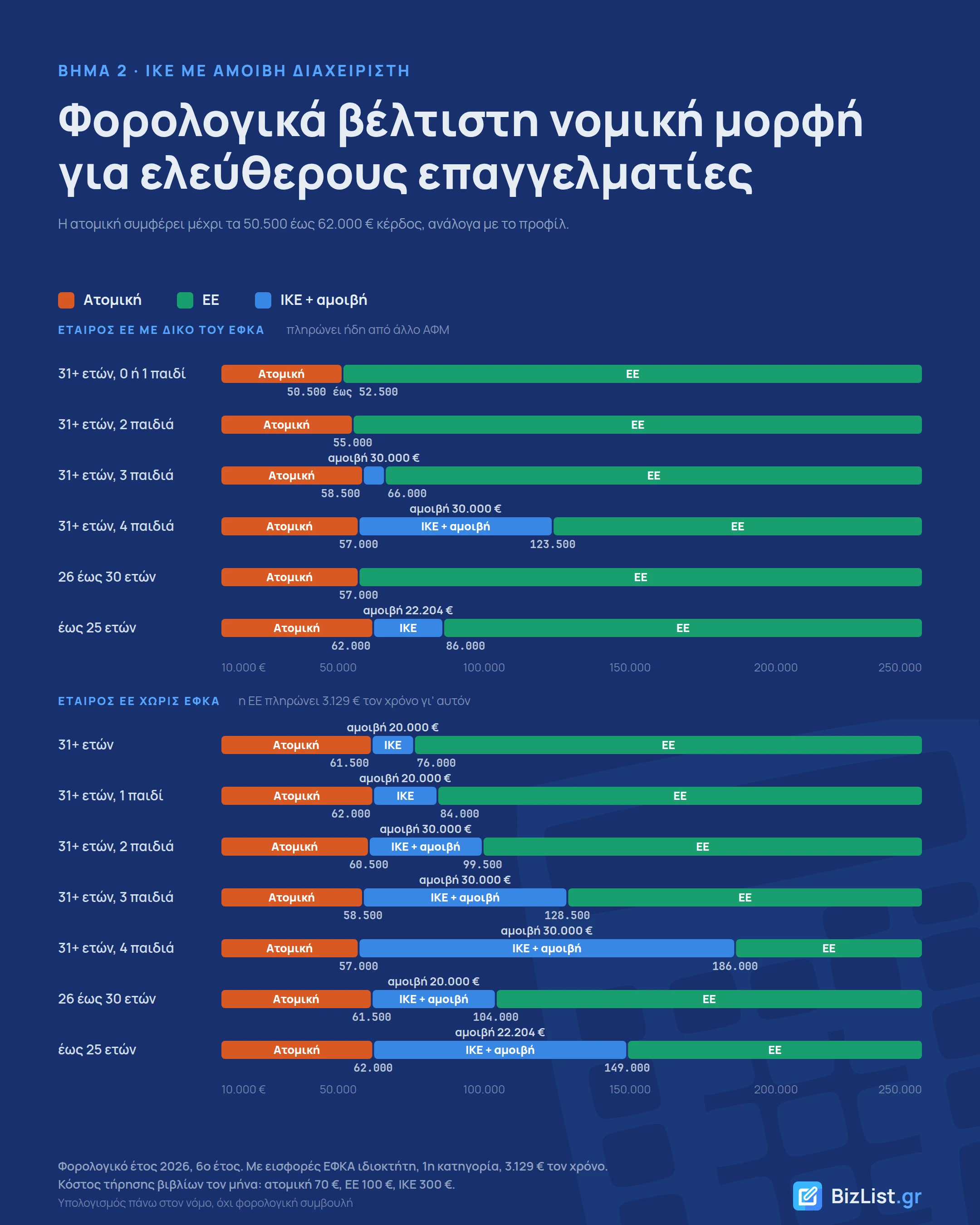
Under the rules of Greek tax year 2026, a sole proprietorship leaves the most to the owner up to €45,500 to €61,000 of profit, and above that the limited partnership (EE), especially with a parallel sole proprietorship. The private company (IKE) with manager's pay comes first only with two or more children, and only if the EE would pay social security (EFKA) for the limited partner: with four children, from €57,000 to €79,500 of profit.
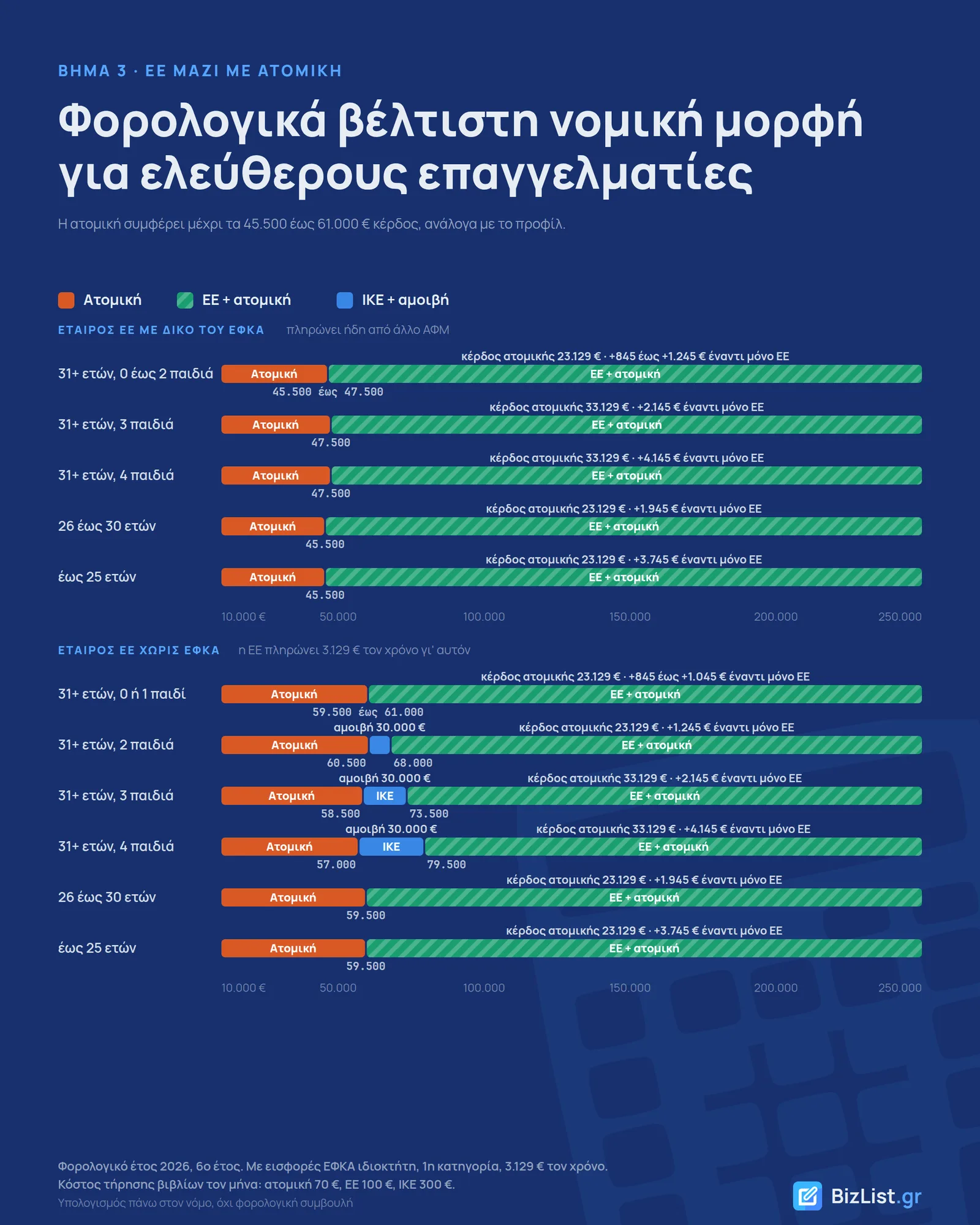
Private company (IKE) or sole proprietorship, and where the limited partnership (EE) fits in: in Greece, the legal form that pays best after tax depends mainly on profit. Under the rules of tax year 2026, a sole proprietorship leaves the most to the owner up to €45,500 to €61,000 of profit, depending on the profile. Above that, the limited partnership moves ahead.
I wrote the rules into a model and calculated what is left to the owner at 481 profit levels, in steps of €500 from €10,000 to €250,000. I ran it for 14 profiles: seven combinations of age and children, with and without a limited partner who already pays EFKA, the Greek social security fund, from elsewhere.
The IKE comes first only when two conditions hold together: the owner has two or more children, and there is no limited partner who already pays EFKA. With four children its zone is €57,000 to €79,500 of profit.
What is left to the owner, by profit
An owner over 30, with no children, no other income, in the 6th year of activity. The limited partner of the EE already pays EFKA as an employee or as a self-employed professional, so the EE pays nothing for them:
| profit | sole proprietorship | EE | IKE with manager's pay | EE and parallel sole proprietorship |
|---|---|---|---|---|
| €20,000 | €13,925 | €11,361 | €10,902 | €12,063 |
| €30,000 | €21,563 | €19,161 | €18,496 | €20,006 |
| €40,000 | €28,480 | €26,961 | €25,906 | €27,806 |
| €50,000 | €34,779 | €34,761 | €33,316 | €35,606 |
| €70,000 | €46,677 | €50,361 | €48,136 | €51,206 |
| €100,000 | €63,477 | €73,761 | €70,366 | €74,606 |
| €150,000 | €91,477 | €112,761 | €107,416 | €113,606 |
| €200,000 | €119,477 | €151,761 | €144,466 | €152,606 |
Profit is revenue minus expenses, before the owner is paid and before the costs that change with the legal form: EFKA contributions, accountant, business levy, GEMI (the General Commercial Registry) fees. Each column subtracts its own. The contributions are those of the 1st category, €3,129 a year, and they are deducted from the profit of the sole proprietorship and from the profit of the EE. In the IKE the model does not deduct them anywhere, for the reason explained in the IKE section.
At €100,000 the sole proprietorship leaves €11,129 less than the EE with a parallel sole proprietorship.
Sole proprietorship or EE: the profit where it changes
A sole proprietorship taxes its profit with the scale of Article 15 of the Income Tax Code (KFE, Law 4172/2013, Government Gazette FEK A 167/2013), as replaced for tax years from 2026 by Article 3 of Law 5246/2025 (FEK A 198/11.11.2025): 9% up to €10,000, 20% up to €20,000, 26% up to €30,000, 34% up to €40,000, 39% up to €60,000 and 44% above that.
An EE with single-entry books pays 22% on profit from the first euro (Article 58 KFE, as in force under Article 120 of Law 4799/2021, FEK A 78/18.05.2021), and the distribution to the partners is not taxed again. But it pays the €800 business levy ("telos epitidevmatos", an annual flat charge on businesses) and a more expensive accountant. Article 3 of Law 5162/2024 (FEK A 198/05.12.2024) kept the levy only for legal entities, when it replaced Article 31 of Law 3986/2011.
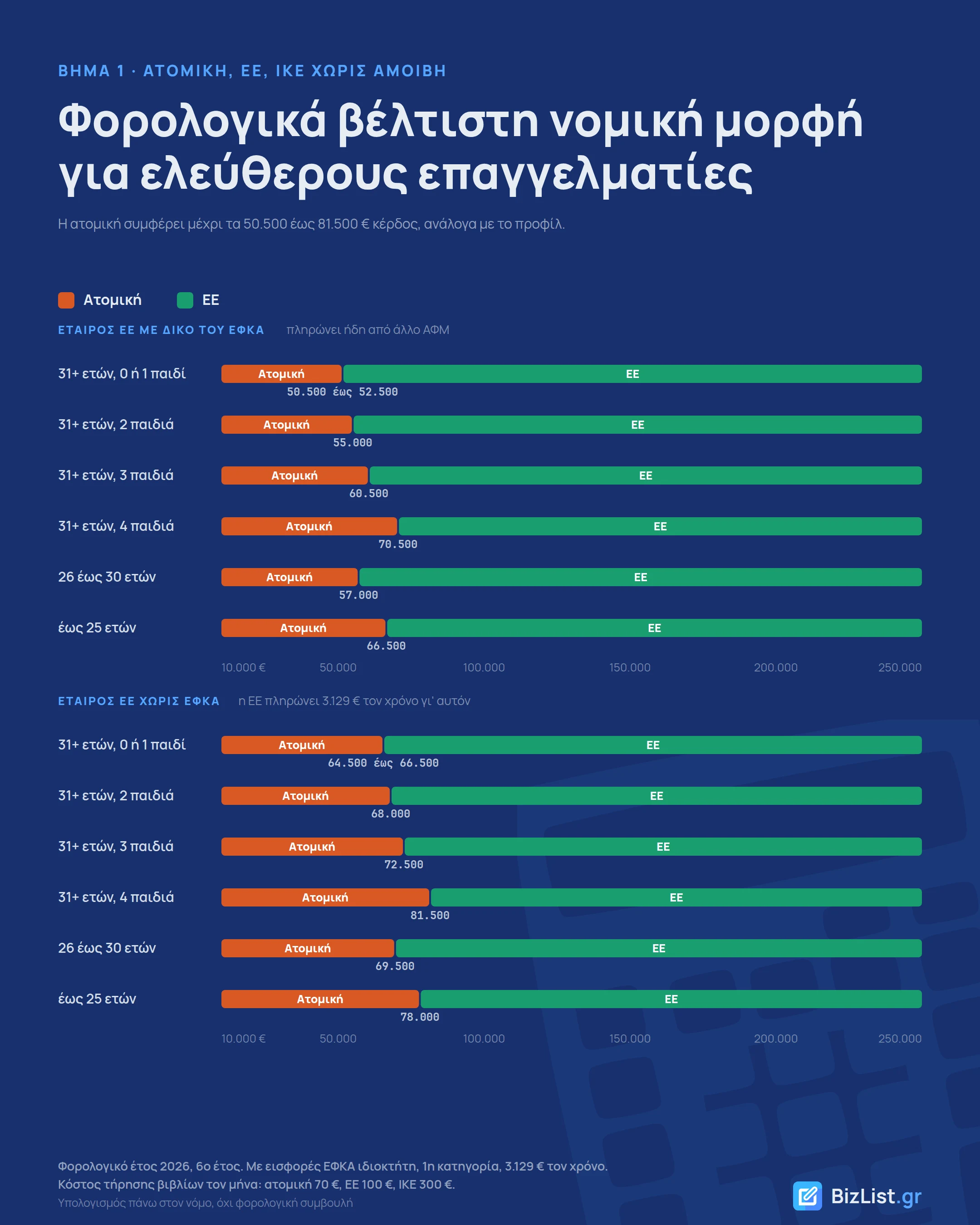
As long as profit stays in the cheap brackets, the sole proprietorship wins. With a limited partner who already pays EFKA, the EE moves ahead at €50,500 in the base profile and at €70,500 with four children.
The contributions themselves also count, because they are not deducted the same way everywhere. The €3,129 is worth:
| profit | sole proprietorship | EE | IKE with pay | EE with sole proprietorship |
|---|---|---|---|---|
| €20,000 | €626 | €688 | €0 | €688 |
| €30,000 | €814 | €688 | €0 | €688 |
| €50,000 | €1,220 | €688 | €0 | €688 |
| €70,000 and above | €1,377 | €688 | €0 | €688 |
In the EE the deduction always applies at the company rate, 22%. The same holds when there is a parallel sole proprietorship next to it: there the optimal share moves by the amount of the contribution and the profit goes back to the EE. In the sole proprietorship the deduction applies at the owner's marginal rate, which is 44% at high profits.
With profit up to €16,500 the sole proprietorship is usually taxed on the deemed income of €12,880, because contributions and the accountant bring the declared profit below it. This is the minimum deemed income of Articles 28A to 28D KFE, added by Law 5073/2023 (FEK A 204/11.12.2023): 14 times the minimum wage of €920. Under the AADE circular E.2027/16.04.2024 (AADE is the Greek tax authority), it applies only to the sole proprietorship. It does not apply for the first three years from the first start of activity (Article 28C(1) KFE, as in force under Article 6 of Law 5246/2025).
The EE is also the form that grew tenfold in new registrations in GEMI since 2016 and has overtaken the IKE since 2024.
The limited partner and the €3,129 of EFKA
An EE needs at least two partners. Under the EFKA circular 21/22.04.2019 every partner of a general partnership (OE) or an EE must be insured, with no condition on share or management. If the limited partner is not already insured elsewhere, the EE also pays for them the 1st category for the self-employed: €250.77 a month plus €10 for DYPA (the Greek public employment service), under the e-EFKA circular 6/03.02.2026. That is €3,129 a year. After the tax it saves, €2,441 is missing from the owner.
Then the sole proprietorship stays ahead of the EE up to €64,500 in the base profile and up to €81,500 with four children. But in this case the IKE comes in between.
IKE taxation in 2026 and the manager's pay
A single-member IKE without pay for the manager pays 22% on profit and 5% on the dividend that is left, which is 25.9% in total, plus the €800 business levy and the most expensive accountant of the three. The 5% applies to dividends from 1/1/2020, under Article 24 of Law 4646/2019 (FEK A 201/12.12.2019). In none of the 14 profiles does the IKE without pay come first.
The manager's pay changes the account. It is taxed as a salary (Article 12(2)(d) KFE), with the scale and the tax reduction of Article 16, and it is deductible in the IKE. But the owner's contributions do not reduce tax anywhere: the company does not deduct them, and an employee cannot deduct expenses. Circular POL.1113/2015, section b(i), says that the contributions of an IKE partner "will be deducted from their income from employment services". But the text dates from 2015, and the model keeps the conservative reading. The other reading is worth €810 a year and is in the methodology. Under Article 39 of Law 4387/2016 (FEK A 85/12.05.2016), the manager of an IKE is insured as self-employed, so the pay does not carry employee contributions through the APD, the monthly payroll return to EFKA.
The pay is worth it as long as its tax stays below the 25.9% on the dividend. In the bracket from €20,000 to €30,000 the rate is 26% without children. The reduction of Article 16, €777 without children, falls by €20 for each €1,000 of salary above €12,000, which is 2 more points. So it is 28% without children and 26% with one, and the pay stops at €20,000. With two children it comes to 24% and rises to €30,000.
| profile, profit €100,000 | pay | gain against dividend only |
|---|---|---|
| over 30, no children | €20,000 | +€2,897 |
| 1 child | €20,000 | +€3,220 |
| 2 children | €30,000 | +€3,830 |
| 3 children | €30,000 | +€4,950 |
| 4 children | €30,000 | +€7,190 |
| 26 to 30 years old | €20,000 | +€3,997 |
| up to 25 years old | €22,204 | +€5,751 |
In the EE the same move costs money. The management pay of the general partner is also taxed as a salary (POL.1139/30.06.2015, para. 4). But under the EFKA circular 21/2019 it carries employee contributions through the APD, on top of the self-employed category. With the contributions of the circular, 34.10%, the optimal pay came out at €0 in every profile, so the EE stays with plain distribution.
EE with a parallel sole proprietorship
The general partner can also have their own sole proprietorship, and part of the profit can be taxed there with the scale. It is the same logic as the manager's pay in the IKE: the cheap brackets fill up, and the rest stays at the 22% of the EE. The contributions are paid once and are deducted in the sole proprietorship (POL.1113/2015, partner of an OE/EE who also has a sole proprietorship).
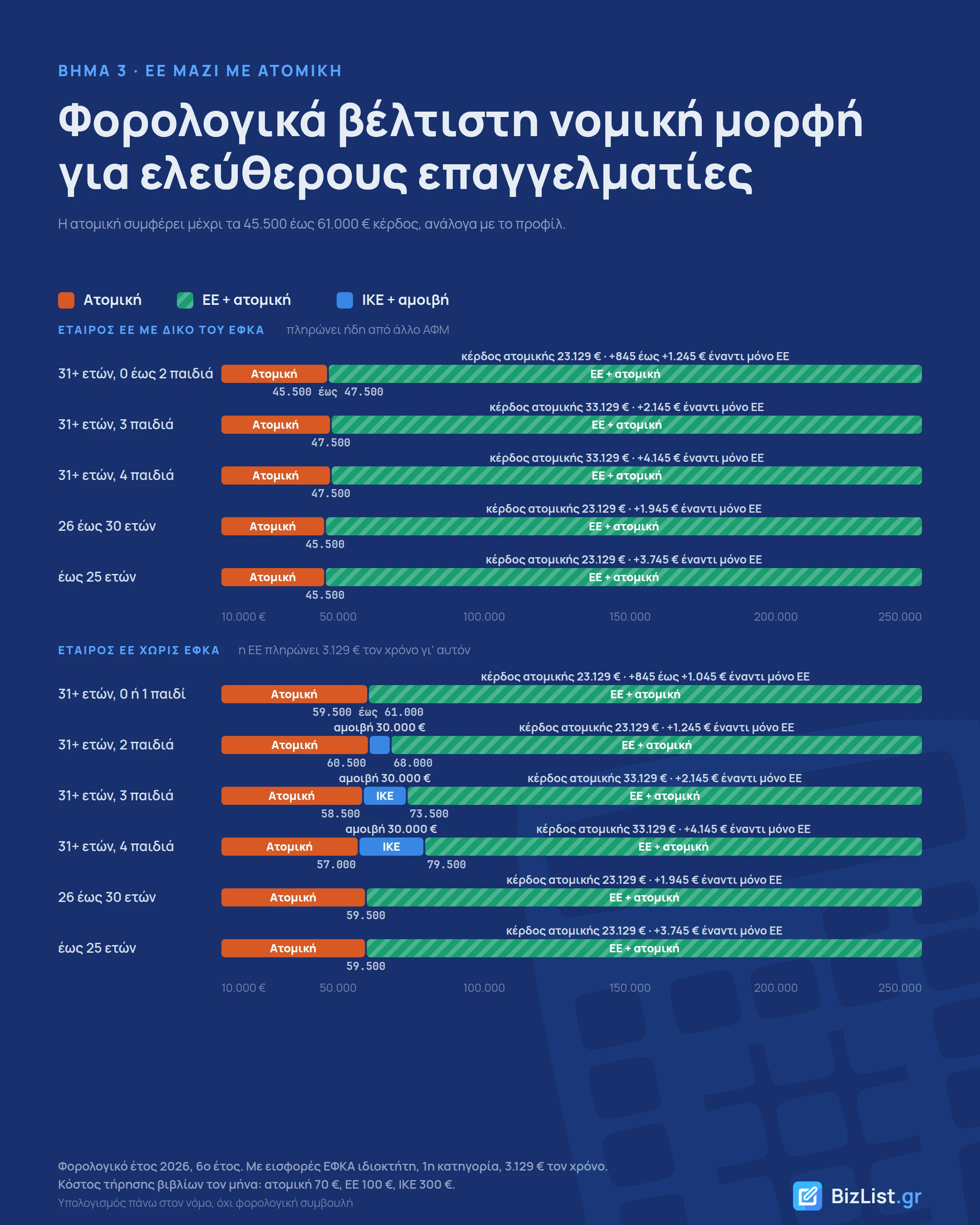
| profile, profit €100,000 | profit in the sole proprietorship | gain against EE only |
|---|---|---|
| over 30, no children | €23,129 | +€845 |
| 1 child | €23,129 | +€1,045 |
| 2 children | €23,129 to €33,129 | +€1,245 |
| 3 children | €33,129 | +€2,145 |
| 4 children | €33,129 | +€4,145 |
| 26 to 30 years old | €23,129 | +€1,945 |
| up to 25 years old | €23,129 | +€3,745 |
The gain already subtracts the €840 of the second accountant. Without children it is small, and it holds only under conditions:
- Separate clients, no invoices between them. It is recommended that the sole proprietorship and the EE do not invoice each other, and that each has its own clients for the same work. If the sole proprietorship invoices the EE, POL.1113/2015 accepts the deduction in the EE only for a specific job. If the service is the work that the partner owes as a partner, it counts as a drawing of profits and is not deductible.
- Real substance. A sole proprietorship without substance of its own falls under the anti-abuse rule of Article 39 of Law 5104/2024 (FEK A 58/19.04.2024). The rule is applied in small cases too. For an engineer, general partner of an EE, the tax office assessed tax of €7,227.80 and a fine of €3,613.90, because his sole proprietorship took on a job of the EE. DED 267/2025, a decision of the tax appeals body of AADE, annulled the assessment: the burden of proof is on the tax office, and the tax gain alone does not make an arrangement artificial. Separate clients, separate contracts and the same prices in both forms give an audit less to work with.
- One contribution. A person who carries on two self-employed activities pays one main pension contribution (Article 36(1)(b) Law 4387/2016). The model assumes this applies to a general partner with a sole proprietorship.
EE or IKE: when the IKE finally wins
With all the options in, the order for tax year 2026 is:
| profile | limited partner with own EFKA | limited partner without EFKA |
|---|---|---|
| over 30, no children | sole proprietorship up to €45,500, then EE with sole proprietorship | sole proprietorship up to €59,500, then EE with sole proprietorship |
| 1 child | sole proprietorship up to €46,500, then EE with sole proprietorship | sole proprietorship up to €61,000, then EE with sole proprietorship |
| 2 children | sole proprietorship up to €47,500, then EE with sole proprietorship | sole proprietorship up to €60,500, IKE up to €68,000, then EE with sole proprietorship |
| 3 children | sole proprietorship up to €47,500, then EE with sole proprietorship | sole proprietorship up to €58,500, IKE up to €73,500, then EE with sole proprietorship |
| 4 children | sole proprietorship up to €47,500, then EE with sole proprietorship | sole proprietorship up to €57,000, IKE up to €79,500, then EE with sole proprietorship |
| 26 to 30 years old | sole proprietorship up to €45,500, then EE with sole proprietorship | sole proprietorship up to €59,500, then EE with sole proprietorship |
| up to 25 years old | sole proprietorship up to €45,500, then EE with sole proprietorship | sole proprietorship up to €59,500, then EE with sole proprietorship |
The IKE needs two things together to come first. Two or more children, so that the €30,000 pay is taxed cheaply. And a limited partner without their own EFKA, so that the EE pays a second contribution. With a limited partner who is already insured, it does not come first in any profile.
Children and age in the 2026 tax scale
Law 5246/2025 cut the rates of the first three brackets according to children and age. Under Article 47(3) of the same law, the reductions apply from tax year 2026, so in 2025 the scale was the same for everyone. Above €30,000 it is the same for everyone in 2026 too: 34%, 39%, 44%.
| up to €10,000 | €10,000 to €20,000 | €20,000 to €30,000 | |
|---|---|---|---|
| no children | 9% | 20% | 26% |
| 1 child | 9% | 18% | 24% |
| 2 children | 9% | 16% | 22% |
| 3 children | 9% | 9% | 20% |
| 4 children | 0% | 0% | 18% |
| up to 25 years old | 0% | 0% | 26% |
| 26 to 30 years old | 9% | 9% | 26% |
In euros, from €30,000 of taxable income upwards, the tax falls by €400 a year with one child, €800 with two, €1,700 with three and €3,700 with four. Below €30,000 the reduction is smaller.
The same scale applies to the sole proprietorship, to the salary of the IKE manager and to the profit of the parallel sole proprietorship. This is why the threshold of the sole proprietorship hardly moves with children, while the IKE pay and the share of the sole proprietorship next to the EE go up.
The 15% on distributions above €60,000
On 7 September 2026 the Greek Ministry of National Economy and Finance announced 15% instead of 5% on profits distributed to managers and board members, on the part above €60,000 a year, for payments from 1/1/2027. The same text says that the measures "have not yet been enacted", and on 15 September no bill had been tabled.
If it passes as announced, the IKE with €20,000 pay goes over €60,000 of distribution at about €102,000 of profit. At €150,000 the optimal pay rises to €30,000, and the IKE loses €3,201 at €150,000 and €7,101 at €200,000. With the EE and the parallel sole proprietorship in, none of the thresholds shown above changes.
The same announcement says that shareholders' dividends stay at 5%. Whether the sole partner of an IKE counts as a manager or as a shareholder will show in the text of the law.
How many IKEs make less than the threshold
Of the 115,303 active IKEs in Greece, 49,719 have filed 2024 financial statements in GEMI. 15,314 reported a loss. The other 34,405 are distributed like this:
| 2024 pre-tax profit | IKEs | share | cumulative |
|---|---|---|---|
| up to €20,000 | 13,426 | 39.0% | 39.0% |
| €20,000 to €50,000 | 8,166 | 23.7% | 62.8% |
| €50,000 to €80,000 | 3,883 | 11.3% | 74.0% |
| €80,000 to €150,000 | 3,987 | 11.6% | 85.6% |
| over €150,000 | 4,943 | 14.4% | 100.0% |
The median profit of all of them, with the loss-making ones included, is €11,937. The profitable IKEs with profit up to €50,000 are 21,592, that is 62.8%, around or below the threshold up to which the sole proprietorship leaves the most.
The profit in the financial statements is after the manager's pay, so the profit before the owner is paid is higher. To capture it, I added all staff costs to the profit, since the manager's pay is part of them. Companies that are dormant in practice, with revenue under €500 and no profit, are left out. Of the 36,443 IKEs that report staff costs, in 19,553, that is 53.7%, the sum is under €45,500, and in 60.3% under €61,000. The sum also counts employees' wages, so the share is a lower bound: at least half of IKE owners would keep more money with a plain sole proprietorship.
And the IKE is chosen for reasons that tax does not measure: limited liability, many partners, clients who want a company. The general partner of an EE is liable with their own assets.
Methodology
The rules are as they stood on 15 September 2026, with the texts cited next to each rule. The model amounts are calculations on the law, not measurements. The financial statements are for 2024, from GEMI, retrieved on 15 September 2026. The sum of profit and staff costs was retrieved on 17 October 2026, when 51,902 IKEs had 2024 statements. Of these, 384 dormant ones and 15,075 that do not report staff costs are left out.
Assumptions: 6th year of activity, so 1st category contributions without the discount of the first five years and without the half first bracket for new businesses. Accountant at €70 a month for a sole proprietorship, €100 for an EE, €300 for an IKE, which is an estimate within the market range. Business levy of €800 for the EE and the IKE, in a town of up to 200,000 inhabitants. Minimum wage €920, as in force from 1/4/2026 (joint ministerial decision KYA 8934/27.03.2026). No staff, no other income, a limited partner with no share in the profits. The advance tax payment is left out, because it changes when you pay (analysis of the advance payment).
The most costly open point is the treatment of the IKE manager's contributions. The model assumes that they are not deductible anywhere. If they are deductible from the manager's pay, as POL.1113/2015 section b(i) says, the IKE gains €810 a year at every profit level, the optimal pay rises from €20,000 to €23,129, and the IKE comes first in the base profile too, from €55,500 to €75,000 of profit.
If the owner's contributions were left out of the comparison, all the thresholds would fall by €3,000 to €10,000, and the order of the forms would not change in any of the 14 profiles. The IKE moves ahead of the sole proprietorship at €61,500. Without the business levy this falls to €55,500, in the first three years to €58,000, and without contributions to €52,000. If the owner already has a salary or freelance invoice income, that income has already filled the cheap brackets and all the thresholds fall.
Two things changed along the way. The first version also gave the EE a manager's pay, with salary tax and no contributions. The EFKA circular 21/2019 puts employee contributions on the pay of the general partner, and the optimal pay fell to zero. And on the "EE with a parallel sole proprietorship" route, the model charged the contribution twice, once on each leg, while it is paid once and deducted in the sole proprietorship.
Three more points are interpretations without an explicit source: that the pay of the manager of a single-member IKE does not carry APD contributions, that a limited partner insured elsewhere does not pay a second contribution, and that one contribution covers a general partner with a parallel sole proprietorship. Zones narrower than €3,000 are merged with the previous one. A calculation on the law, not tax advice.
Frequently asked questions
IKE or sole proprietorship: which pays better after tax in Greece?
How many Greek IKEs would be better off as sole proprietorships?
How is a Greek IKE taxed in 2026?
How much manager's pay makes sense in a single-member IKE?
Does the limited partner pay EFKA?
Can an EE partner also have a sole proprietorship?
Does an IKE pay tax on deemed income?
Sources
- Law 4172/2013 (Greek Income Tax Code, KFE) Article 15, income tax scale accessed 15 Σεπτεμβρίου 2026
- Law 4172/2013 (KFE) Article 12, income from employment, cases (d) and (f) accessed 15 Σεπτεμβρίου 2026
- Law 4172/2013 (KFE) Article 58, tax rate for legal entities accessed 15 Σεπτεμβρίου 2026
- Law 5246/2025 (FEK A 198/2025), new tax scale and reductions for children and young people accessed 15 Σεπτεμβρίου 2026
- AADE (Greek tax authority), circular E.2027/2024, minimum deemed income of sole proprietorships accessed 15 Σεπτεμβρίου 2026
- Law 4387/2016 Article 39, contributions of the self-employed accessed 15 Σεπτεμβρίου 2026
- e-EFKA (Greek social security fund), circular 21/2019, insurance of partners and managers of OE, EE, EPE and IKE accessed 15 Σεπτεμβρίου 2026
- e-EFKA, circular 6/2026, contribution amounts for the self-employed in 2026 accessed 15 Σεπτεμβρίου 2026
- POL.1113/2015, deductible expenses and pay of partners accessed 15 Σεπτεμβρίου 2026
- POL.1139/2015, pay of managers and partners accessed 15 Σεπτεμβρίου 2026
- Law 5104/2024 Article 39, general anti-abuse rule accessed 15 Σεπτεμβρίου 2026
- DED 267/2025 (Thessaloniki, 19/02/2025), anti-abuse rule for a general partner with a sole proprietorship accessed 20 Οκτωβρίου 2026
- Greek Ministry of National Economy and Finance, presentation of measures, September 2026 accessed 15 Σεπτεμβρίου 2026
- GEMI registry (Greece), 2024 financial statements, via BizList.gr accessed 15 Σεπτεμβρίου 2026
Data snapshot taken on 15 Σεπτεμβρίου 2026.
The bizlist.gr analyses are information drawn from public data and do not constitute tax, accounting, legal or financial advice.
Try it yourself
The same filters used in this analysis, ready to run.
A full study of your industry?
Companies, revenue, profit and the largest players in your industry, across Greece. Free for subscribers.