The Greek advance tax payment: is it as unfair as it looks?
I compared the Greek advance corporate tax payment, 80% assessed in July and paid in 8 instalments, with the quarterly system that other countries use, for a Greek private company (IKE) with a profit of €10,000 a month. With steady profit the business keeps €9,680 more in its cash account. It hurts only after a sharp rise: a company that triples its profit for one year pays in July 156% of the tax for that financial year.
The advance tax payment in Greece (prokatavoli, a prepayment of next year's income tax that is assessed together with this year's tax) is, under the rules in force in August 2026, 80% for legal entities and 55% for sole proprietorships. Law 4799/2021 brought them down to these levels from 100%, which was the rule until then. You prepay tax on profits that you have not made yet, and at first sight this looks unreasonable.
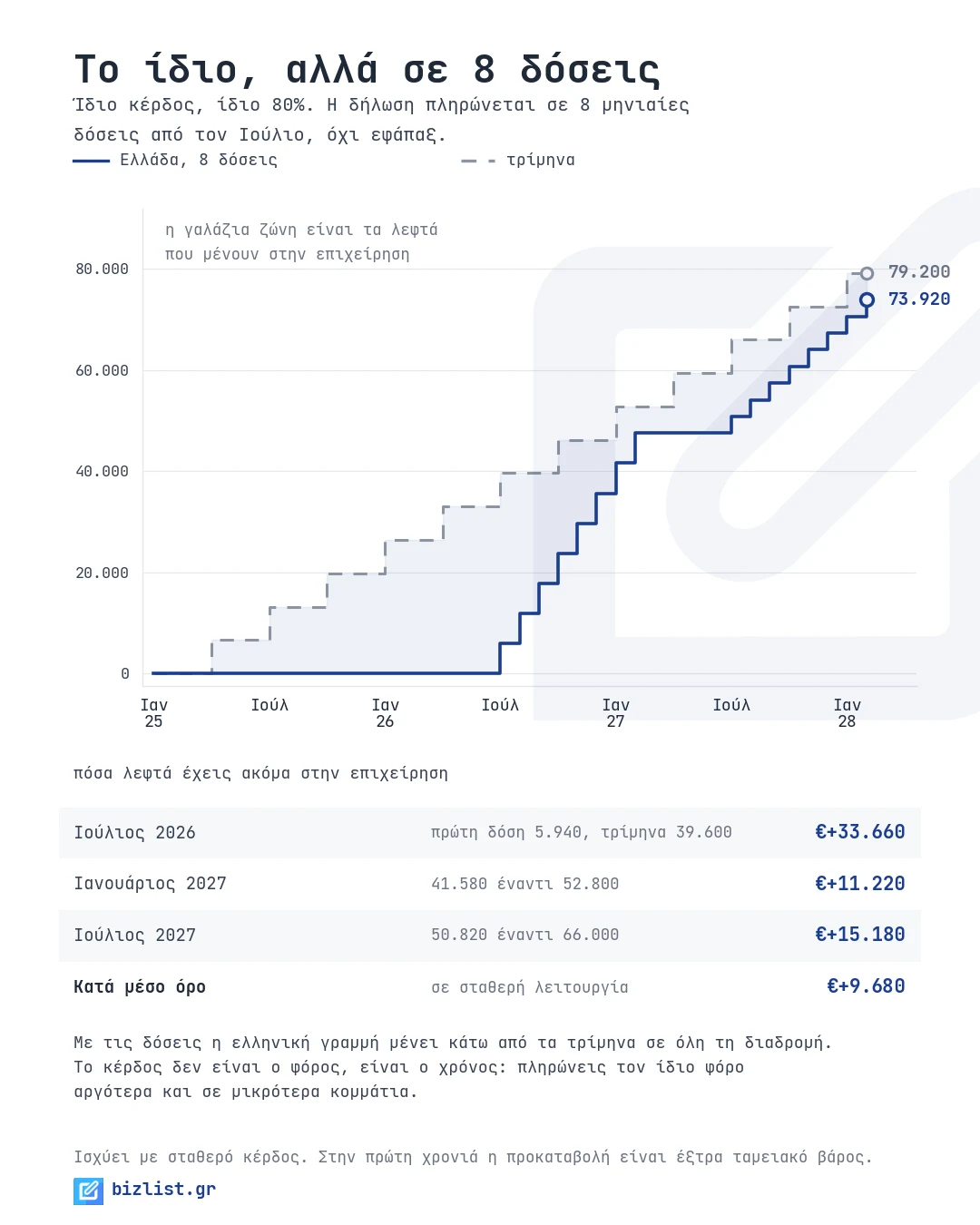
I built the payment schedule of a Greek private company (IKE) with a steady profit of €10,000 a month and put it next to the quarterly system that other countries use. The Greek business keeps on average €9,680 more in its cash account.
The calculation turns in one case: when profit jumps for one year. A firm that triples its profit pays in July 156% of the tax for that financial year.
What you pay in July
The tax return for financial year 2025 is assessed in July 2026, and the assessment covers three things together: the tax for 2025, minus the advance already paid for 2025, plus the advance for 2026.
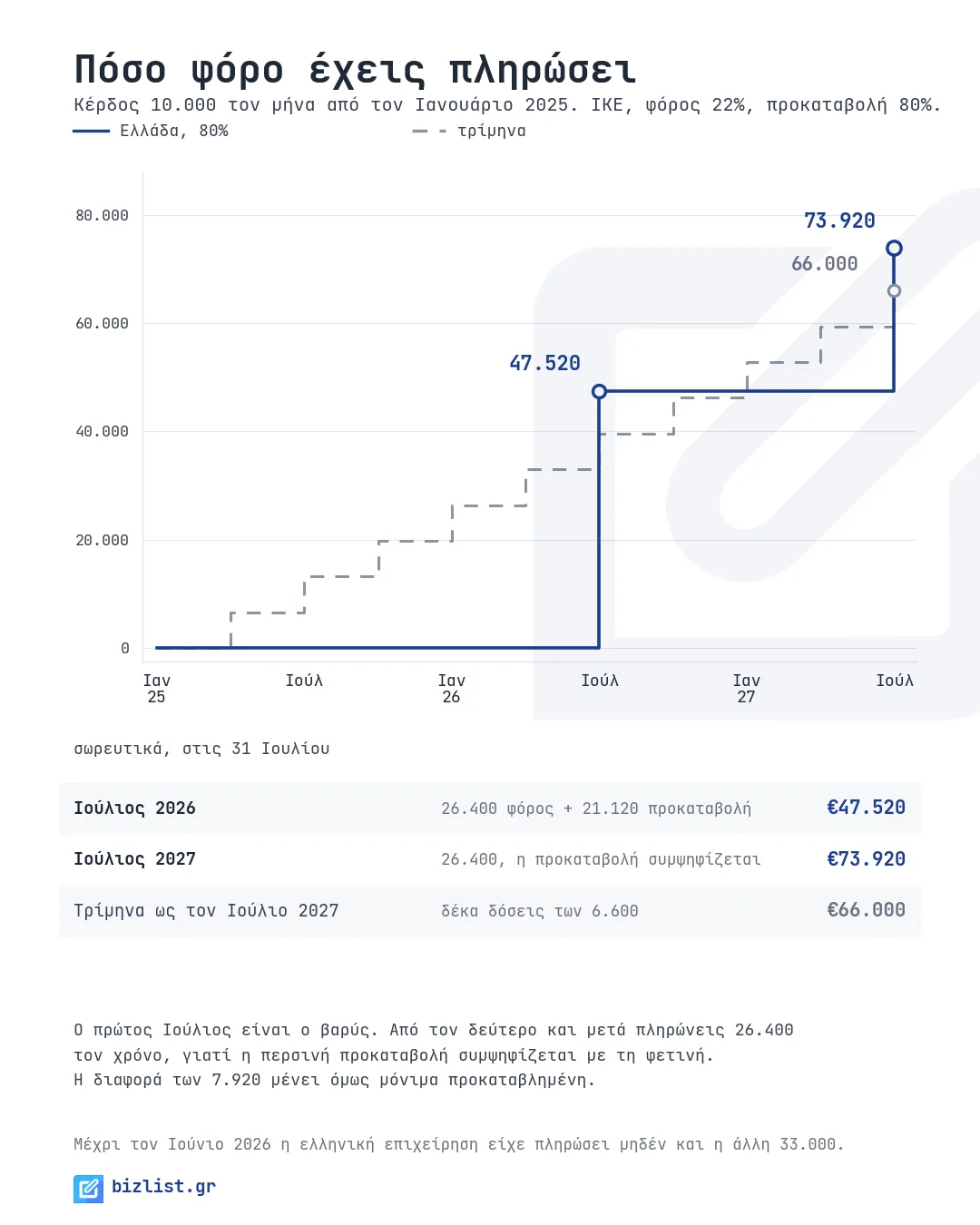
Profit of €120,000 a year, corporate tax rate 22%, so €26,400 of tax for the financial year. If 2025 is the first year of the company, there is no advance from last year to offset:
| tax for financial year 2025 | €26,400 |
| plus advance for 2026, 80% × €26,400 | +€21,120 |
| assessed in July 2026 | €47,520 |
It is paid in 8 monthly instalments of €5,940, from the end of July 2026 to the end of February 2027. In July 2027 the assessment falls to €26,400, because the advance for 2026 is offset against the new one.
So for a year and a half, from January 2025 to June 2026, the business pays nothing in income tax.
When the German pays
The comparison that people usually make is with a quarterly system where you pay in April for January-March, in July for April-June, and so on. It does not work like that in any of the four countries. The instalments fall within the financial year, on an estimate:
| instalments | dates | basis of calculation | |
|---|---|---|---|
| Germany | 4 | 10/3, 10/6, 10/9, 10/12 | last assessment, adjusted |
| USA, corporations | 4 | 15/4, 15/6, 15/9, 15/12 | estimate of the current year |
| Belgium | 4 | 10/4, 10/7, 10/10, 20/12 | estimate, with a tax credit per quarter |
| Spain | 3 | 20/4, 20/10, 20/12 | 18% of the tax for the previous year |
| Greece | 8 | 31/7 to 28/2 of the following year | assessment of the previous year + 80% advance |
The German company pays on 10 March for a quarter that has not closed. The Spanish company pays in April a percentage calculated on last year's tax, which is the same logic as our advance payment. It is an advance payment too, without the name.
All the same, I kept the simple quarterly system as the basis of comparison, because it pays later than each of the four. It is the most conservative version for the quarterly side.
From here on, the numbers are the Greek advance payment against simple quarters, with the same Greek tax of 22% on both sides. No comparison of the tax burden with another country is made here, because no other country taxes at 22% and the amounts would not be comparable.
How much money stays in the cash account
| on | Greece, 8 instalments | quarters | stays in the cash account |
|---|---|---|---|
| 31/07/2026 | €5,940 | €39,600 | €33,660 |
| 31/01/2027 | €41,580 | €52,800 | €11,220 |
| 31/07/2027 | €50,820 | €66,000 | €15,180 |
On 31 July 2026 the Greek business has paid €5,940 and the other one €39,600. The gap narrows as the instalments run, and it opens again every July, without ever reaching zero. In steady state it ranges from €5,280 to €15,180, with an average of €9,680.
The model counts plain euros, without discounting. With discounting the gap opens further, because what is paid later is worth less.
Where it hurts
The offset works as long as last year's tax is similar to this year's tax. When profit jumps, the advance is calculated on the big year, and the offset comes from the small one.
A firm with a steady profit of €60,000, tax €13,200. In 2025 it wins a big project and makes €200,000. In 2026 it goes back to normal.
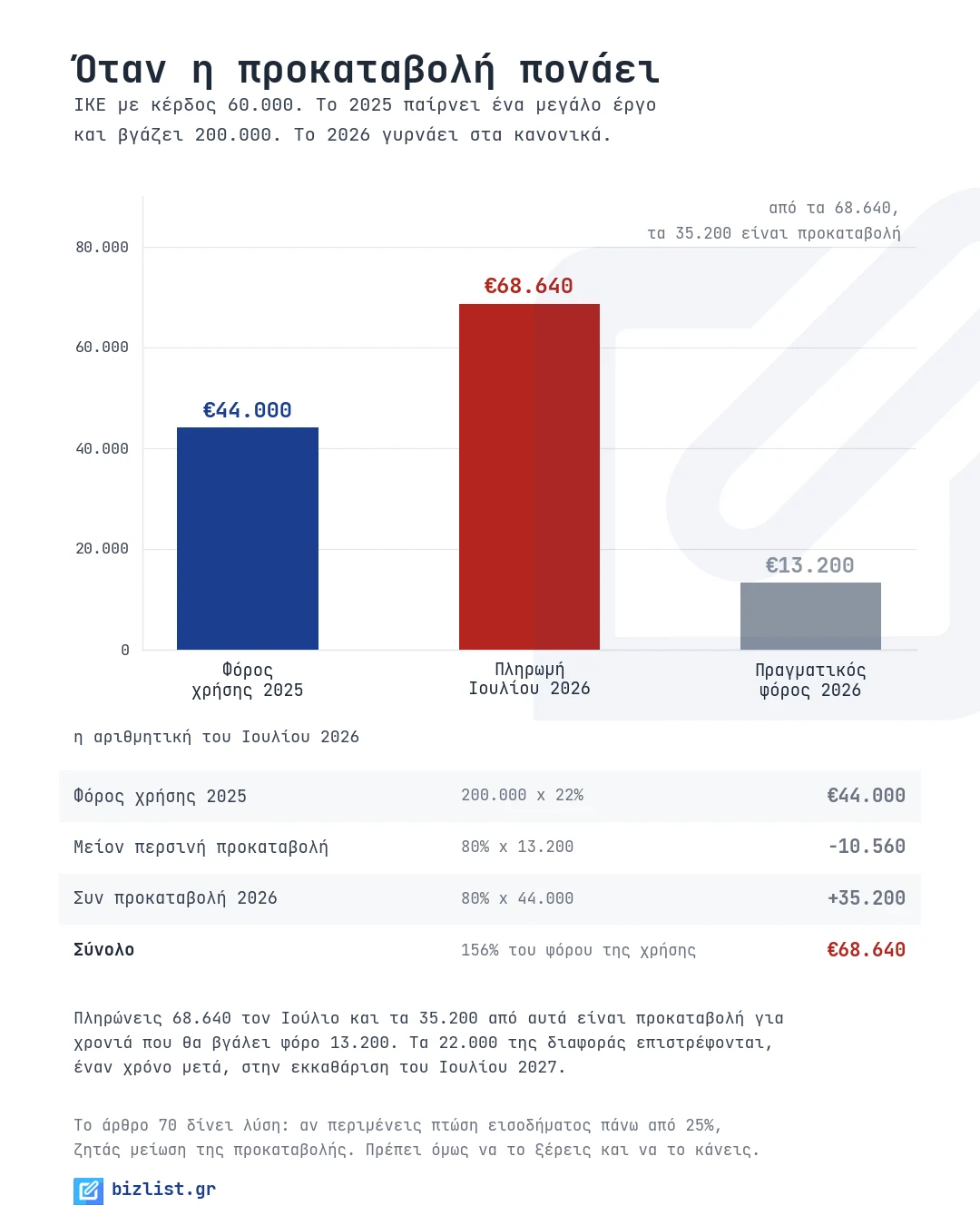
| tax for financial year 2025, €200,000 × 22% | €44,000 |
| minus last year's advance, 80% × €13,200 | −€10,560 |
| plus advance for 2026, 80% × €44,000 | +€35,200 |
| assessed in July 2026 | €68,640 |
The €35,200 is an advance for a year that will produce a tax of €13,200. The €22,000 difference is refunded at the assessment of July 2027, one full year later.
The rise causes it, the fall decides the bill
The intuitive reading is that the next year is to blame, because it does not repeat the big profit. But the July 2026 bill does not even know about that year. It depends only on the tax of 2024 and 2025:
| profit path | July 2026 without advance | July 2026 with 80% | July 2027 without advance | July 2027 with 80% |
|---|---|---|---|---|
| €60,000 → €200,000 → back to €60,000 | €44,000 | €68,640 | €13,200 | −€11,440 |
| €60,000 → €200,000 → stays at €200,000 | €44,000 | €68,640 | €44,000 | €44,000 |
| €60,000 steady | €13,200 | €13,200 | €13,200 | €13,200 |
Without an advance, the July payment is only the tax for the financial year that closed. The advance adds the same €24,640 to July 2026 in both of the first two rows, without knowing what 2026 will do.
The rise creates the hit, because the offset comes from the small year and the new advance from the big one. The fall only decides what happens one year later: if the profit holds, the €35,200 was an advance on real tax. If it falls, the €22,000 difference was an interest-free loan to the state for twelve months.
In euros, the bill balances. By July 2027 the business that went up and came back down has paid €57,200, exactly the tax for financial years 2025 and 2026 together. The cost is the time, not the amount.
The mechanism is symmetric, also without a jump before. If profit falls from €60,000 to one quarter, the July assessment comes out at −€4,620, which is a refund.
The 180% ceiling
How big must the jump be to hurt? With the same €60,000 firm as the basis of comparison:
| profit of the big year | tax for the financial year | July payment | as a share of the tax |
|---|---|---|---|
| €30,000 | €6,600 | €1,320 | 20% |
| €60,000 | €13,200 | €13,200 | 100% |
| €90,000 | €19,800 | €25,080 | 127% |
| €120,000 | €26,400 | €36,960 | 140% |
| €200,000 | €44,000 | €68,640 | 156% |
| €300,000 | €66,000 | €108,240 | 164% |
| €1,200,000 | €264,000 | €464,640 | 176% |
The column on the right never goes past 180%, however much the profit grows. The limit comes from the formula itself: the payment is one tax plus an 80% advance, minus an offset that in the worst case tends to zero. For a sole proprietorship at 55% the ceiling is 155%. For a new IKE at 40% it is 140%.
The other reading of the same table: below a doubling of profit, the July payment stays below 140% of the tax for the financial year. Steady growth actually improves the position of the business, because the advance is always calculated on last year's smaller year, and more money stays in the cash account every year.
The emergency exit
Article 70 of Law 4172/2013, the Greek Income Tax Code, allows an application to reduce the advance payment when income is expected to fall by more than 25% compared with the previous year. Article 71 para. 7 refers to it for legal entities too, with a deadline of nine months from the start of the new financial year, so by the end of September for a company whose year ends on 31 December.
In the example of the €200,000 firm, an application in September 2026 cuts the €35,200 to the level of the actual tax. The provision has been in the Code from the start, and the deadline passes two months after the first instalment, when the assessment is already visible.
The tool applies exactly where the previous section showed the problem to be. It requires an expected fall, so it covers the business that knows in September that it will not repeat the big year. For a plain rise there is no equivalent provision.
New businesses
The rate is cut in half: 40% for legal entities, for the first three years, and 27.5% for sole proprietorships, for the first year.
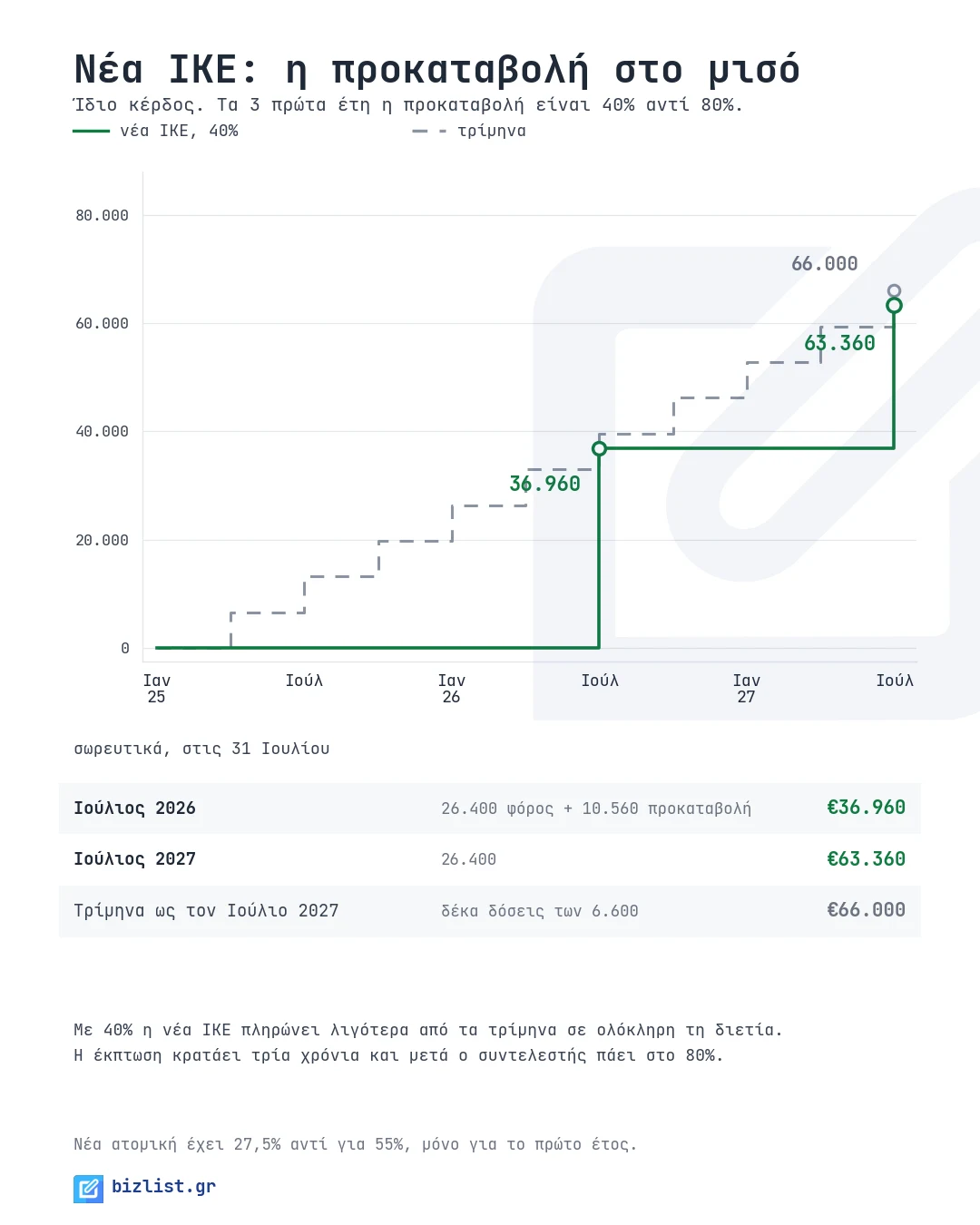
In the same €120,000 example, a new IKE pays €36,960 in July 2026 instead of €47,520, and €63,360 cumulatively by July 2027 instead of €73,920. The companies founded in 2023 are the first cohort that leaves the 40% this year and moves to 80%.
The break-even point is 50%
The advance payment rate has changed three times in a few years and it will change again. The whole scale: every July the Greek line runs above or below the quarterly one by a fixed distance, which depends only on the rate:
| rate | July 2026 | against quarters, every July |
|---|---|---|
| 80%, legal entities today | €47,520 | +€7,920 |
| 55%, sole proprietorships today | €40,920 | +€1,320 |
| 50% | €39,600 | €0 |
| 40%, new legal entities | €36,960 | −€2,640 |
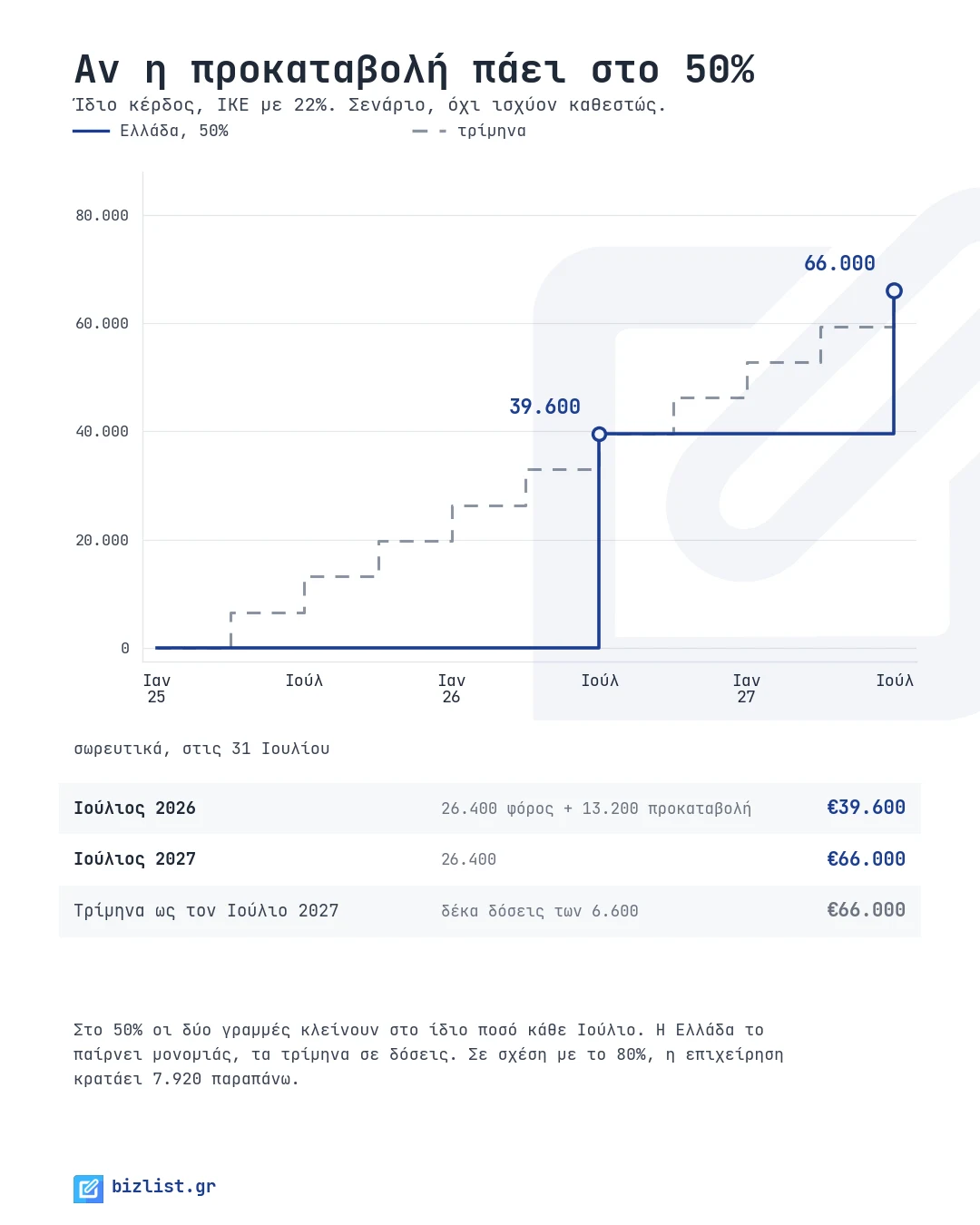
At 50% the Greek schedule closes exactly on the quarterly one: €39,600 in July 2026 and €66,000 in July 2027, the same numbers in both columns. The number is not random. Halfway through the year the quarterly payer has paid half the annual tax, so break-even means a 50% advance.
Above that, the business prepays more than it would have paid in quarters. Below that, less. The current rate for new companies, 40%, is already below the break-even point.
Methodology
The calculations are the whole methodology. No number is measured on a sample of companies.
Greece. Financial year Y is assessed in July Y+1, and the assessment is
tax(Y) − r × tax(Y−1) + r × tax(Y), where r is the advance payment rate, in 8 monthly
instalments up to the end of February Y+2.
Quarters. 25% of the annual tax at the end of April, July, October and January. In the real foreign schedules, each instalment is treated as paid at the end of its month.
Same tax on both sides. The Greek rate of 22% is used everywhere, so that only the payment calendar is compared. The tax burden is not compared with another country.
The measure. Cumulative euros paid at the end of each month. The difference between the two is the money that stays in the cash account, and the average is taken in steady state, not in the first years, when the Greek business pays nothing for a year and a half.
Left out. The business duty (telos epitideumatos, a flat annual levy), withholding taxes, the discount for payment in one lump sum, and interest. The model counts plain euros without discounting, and this favours the quarterly side.
The 22% rate applies to legal entities from financial year 2021. The deadline of Article 70 applies to a tax year that matches the calendar year.
Frequently asked questions
How large is the advance tax payment in Greece today?
Is the Greek advance payment worse than paying in quarters?
When does the advance payment become a real burden?
Can the advance tax payment be reduced?
Sources
- Law 4172/2013 (Greek Income Tax Code), Article 70, reduction of the advance tax accessed 31 Αυγούστου 2026
- Law 4172/2013 (Greek Income Tax Code), Article 71, advance tax payment of legal entities accessed 31 Αυγούστου 2026
- Law 4799/2021 (Government Gazette A΄ 78), reduction of the advance tax payment rates accessed 31 Αυγούστου 2026
- PwC Worldwide Tax Summaries, Germany corporate tax administration accessed 31 Αυγούστου 2026
- PwC Worldwide Tax Summaries, Spain corporate tax administration accessed 31 Αυγούστου 2026
- FPS Finance Belgium, advance payments accessed 31 Αυγούστου 2026
- PwC Worldwide Tax Summaries, United States corporate tax administration accessed 31 Αυγούστου 2026
Data snapshot taken on 31 Αυγούστου 2026.
The bizlist.gr analyses are information drawn from public data and do not constitute tax, accounting, legal or financial advice.
Try it yourself
The same filters used in this analysis, ready to run.
A full study of your industry?
Companies, revenue, profit and the largest players in your industry, across Greece. Free for subscribers.