Greek tutoring schools have ten years: by 2036 there will be 20% fewer teenagers
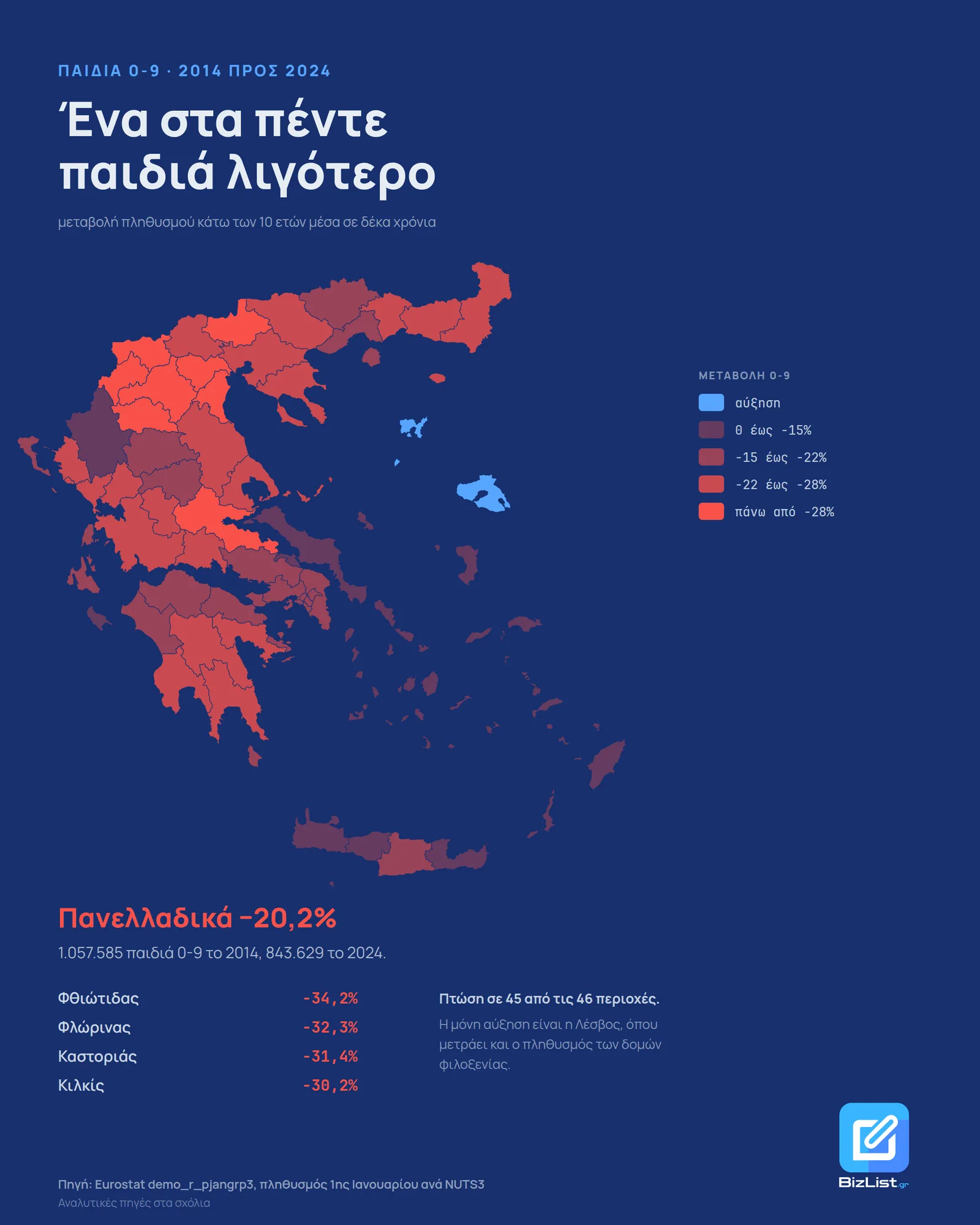
Children aged 0-9 in Greece fell 20.2% in a decade, with a fall in 45 of the 46 areas. Teenagers aged 10-19 have not felt it yet. And the market that serves them looks different if you count VAT numbers and different if you count teachers.
There are 1,059,481 teenagers aged 10-19 in Greece today. In 2014 there were 1,062,610. In ten years the group stayed practically the same, −0.3%.
But behind it, the picture has already changed. Children aged 0-9 fell by 20.2% in the same decade.
The wave has not reached high school yet
| group | 2014 | 2024 | change |
|---|---|---|---|
| 0-4 | 518,279 | 395,215 | −23.7% |
| 5-9 | 539,306 | 448,414 | −16.9% |
| 10-14 | 524,346 | 513,166 | −2.1% |
| 15-19 | 538,264 | 546,315 | +1.5% |
High school today is fuller than in 2014. Kindergarten has lost one child in four.
The arithmetic from here on needs no assumptions about births. Today's 0-9 group is 843,629, and it becomes the 10-19 group in 2036. Compared with today's 1,059,481 teenagers, that is −20.4%. The children are already born. All that is left is for them to grow up.
Where it has already hit
The fall in the 0-9 group is not a national average that hides exceptions. It happens in 45 of the 46 areas.
| area | 2014 | 2024 | change |
|---|---|---|---|
| Fthiotida | 20,150 | 13,264 | −34.2% |
| Florina | 5,006 | 3,389 | −32.3% |
| Kastoria | 4,548 | 3,121 | −31.4% |
| Kilkis | 6,264 | 4,373 | −30.2% |
The only area with an increase is Lesvos, +1.4%, where the population count includes the migrant reception facility. The same explains the increases in the 10-19 group in Chios and Ioannina.
The market that serves them
In GEMI, the General Commercial Registry, there are 2,710 active tutoring schools for lower and upper secondary school. In Greece these private after-school schools ("frontistiria") prepare students for school and for the national university entrance exams. Foreign language centres are another 4,351 and stay outside this analysis: a different market, different ages.
Dividing by the teenagers in each area gives this density:
| area | tutoring schools | per 1,000 teenagers | rank |
|---|---|---|---|
| Thesprotia | 39 | 10.6 | 1 |
| Karditsa + Trikala | 142 | 6.7 | 2 |
| Magnesia | 106 | 5.4 | 3 |
| Greece | 2,710 | 2.6 | |
| Attica | 1,053 and others | 2.2 | 26 |
| Thessaloniki | 1.8 | 35 |
The obvious reading is that the provinces study more. It is the wrong reading, and the data itself shows it.
A VAT number is not a teacher
A tutoring school in Marousi, a suburb of Athens, with fifteen teachers counts as one. Fifteen teachers in Igoumenitsa, each with their own VAT number (Greek tax ID), count as fifteen. The same work, three times the difference on the map.
The legal form confirms it:
| tutoring schools | sole proprietorships | founded before 2010 | |
|---|---|---|---|
| Athens + Thessaloniki | 1,053 | 41.8% | 28.3% |
| rest of Greece | 1,660 | 72.9% | 37.0% |
To measure capacity instead of registrations, each business is converted into teachers. A sole proprietorship counts as one. A general partnership (OE) or limited partnership (EE) counts as three. Private companies (IKE), limited liability companies (EPE) and SAs take the staff costs in their financial statements divided by 15,000 euros a year. Of the 125 large ones, 64 have published staff costs. The rest take the median of 65,524 euros.
| area | per 1,000 teenagers | rank |
|---|---|---|
| Thesprotia | 11.7 | 1 |
| Magnesia | 8.4 | 2 |
| Pella | 7.5 | 3 |
| Greece | 5.1 | |
| Attica | 6.2 | 7 |
| Thessaloniki | 3.9 | 29 |
Attica goes from 26th to 7th. Thessaloniki goes from 35th to 29th. It rises, but stays below the middle.
The conclusion does not depend on the 15,000 euro assumption. Across the whole range from 8,000 to 20,000, Attica stays between 3rd and 7th place:
| cost per teacher | Attica per 1,000 | Attica rank | Thessaloniki rank |
|---|---|---|---|
| €8,000 | 7.85 | 3 | 23 |
| €12,000 | 6.67 | 6 | 27 |
| €15,000 | 6.20 | 7 | 29 |
| €20,000 | 5.73 | 7 | 29 |
Thesprotia stays first in every scenario, because it has almost only sole proprietorships and its factor does not move.
Methodology
Only those registered in GEMI are counted. Private lessons do not pass through the registry and are not counted anywhere, not here and not in any other source. The teacher who teaches at students' homes is outside, and there is no way to estimate the size of that market.
One objection is that education is not a commercial activity, so sole proprietorships do not register. We checked this in the data and it does not hold: 2,718 sole proprietorships founded before 2010 are active in the registry, with no break in 2022. And the provinces have an older stock than the two cities, 37.0% before 2010 against 28.3%. That is the opposite of what under-registration would show.
The absolute number of teachers is a lower bound. The calculation gives about 5,350 nationwide, which is surely too few. An hourly teacher paid on freelance invoices does not appear in any payroll, and a sole proprietorship with two employees counts as one. The comparison between areas holds. The level does not. The factors 1 and 3 are assumptions, not measurements.
Pass rates in the national university entrance exams by area were not found. They would be the natural check of whether tutoring density links to results. But the ministry files have no geographic field. What circulates online is uploaded by individual high schools and tutoring schools with good news, which is a self-selected sample.
The units are 46 and not 51 prefectures. Eurostat NUTS3 does not separate five pairs: Karditsa with Trikala, Arta with Preveza, Grevena with Kozani, Argolida with Arcadia, Laconia with Messinia. The sum of the 46 matches the Eurostat national total to the last person, in both years.
The denominator is 10-19 and not 12-18. Lower and upper secondary school cover ages 12 to 18, but Eurostat gives only five-year groups. The 10-19 group is a little wider at both ends.
Geography is by registered office. A chain with its head office in Athens and branches in the provinces is counted once, in Attica. This pushes the finding down. It does not inflate it.
Frequently asked questions
How much will the student population in Greece fall?
How many secondary school tutoring schools are there in Greece?
Does Athens have fewer tutoring schools per student?
Sources
- Eurostat demo_r_pjangrp3, population on 1 January by age group and NUTS3 accessed 25 Αυγούστου 2026
- GEMI registry (Greece) and 2024 financial statements via bizlist.gr
Data snapshot taken on 25 Αυγούστου 2026.
The bizlist.gr analyses are information drawn from public data and do not constitute tax, accounting, legal or financial advice.
Try it yourself
The same filters used in this analysis, ready to run.
A full study of your industry?
Companies, revenue, profit and the largest players in your industry, across Greece. Free for subscribers.