77% of EU structural funds in Greece do not go to businesses. Where they go
Of the €21.66 billion of the NSRF (ESPA) 2021-2027, the EU structural funds in Greece, 14.4% reaches private businesses. Transport gets 6.5 times more than health.
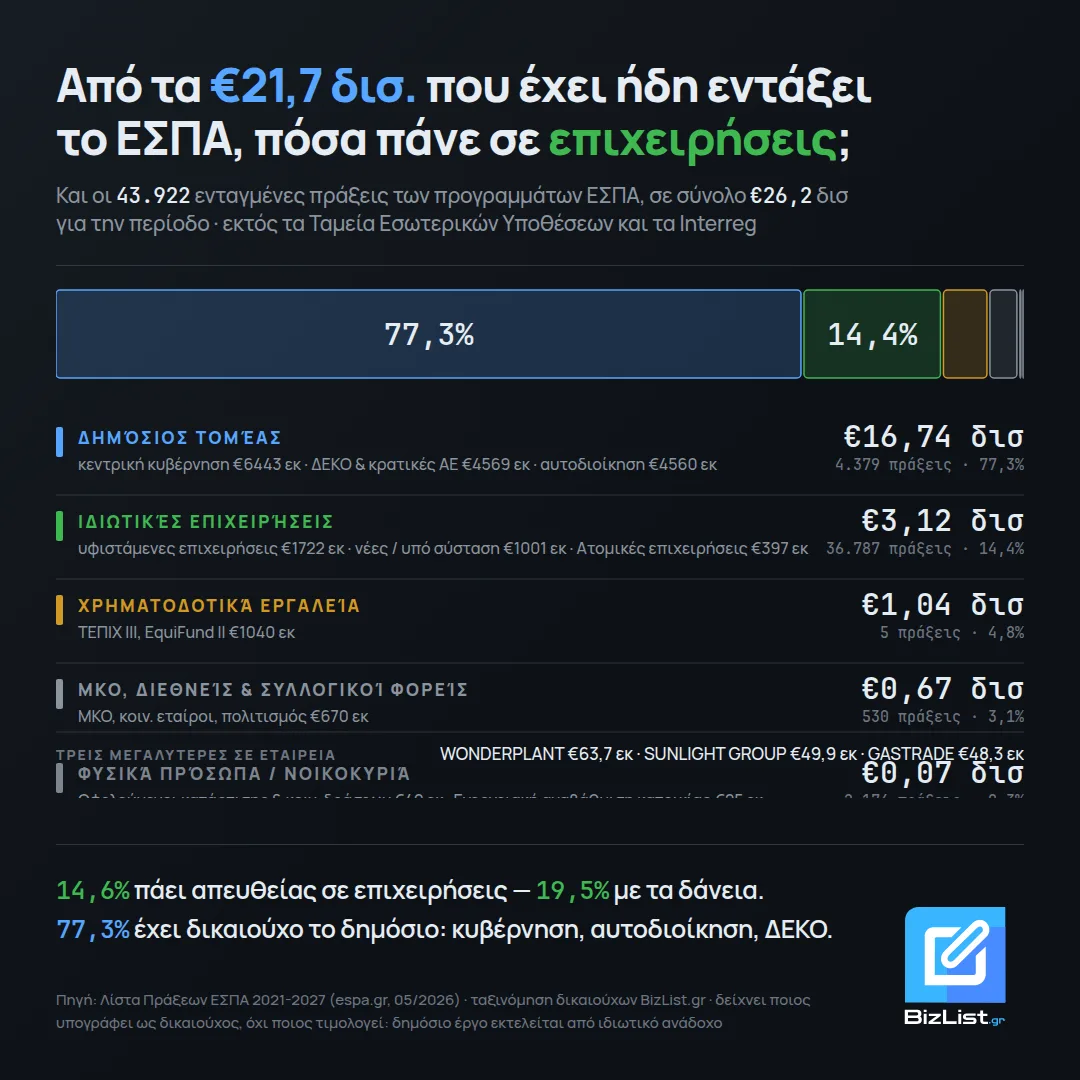
Every time you hear "European funds for entrepreneurship" in Greece, it is worth knowing what share actually reaches a business.
I took all 43,922 approved operations of the NSRF (ESPA), the EU structural funds in Greece, for 2021-2027, €21.66 billion, and matched every beneficiary by VAT number with GEMI, the General Commercial Registry.
One euro in seven
| strand | public expenditure | share |
|---|---|---|
| Public sector | €16.74 billion | 77.3% |
| Private businesses | €3.12 billion | 14.4% |
| Other | the remainder |
If you also count the financial instruments, TEPIX and EquiFund, which reach businesses as loans or equity, the share rises to 19.2%.
The difference in scale is the most telling number: the average public sector operation is €3.82 million, the average business operation €85k, and the median €17k
23 operations hold 28.6% of all the money.
This is partly logical. The metro and hospitals cannot have a private beneficiary, and part of the money ends up with contractors and suppliers anyway. But the number is worth knowing when you hear about "entrepreneurship funds".
What the 77% does
I looked at the €18.47 billion of the public strand, 4,961 operations, with the official EU intervention field code.
| field | amount | share | operations | average operation |
|---|---|---|---|---|
| Transport | €3.50 billion | 19.0% | 136 | €25.8 million |
| Health | €539 million | 2.9% | 296 | €1.8 million |
Transport gets 6.5 times more than health. And in 136 operations against 296, that is in far fewer and far larger projects.
The Hellenic Metro on its own is €1.37 billion. Without it the gap falls to 3.9 times. It falls, it does not disappear.
Which businesses receive funds
For the business strand I found in GEMI the founding date, the activity code (KAD, the Greek extension of NACE) and the registered seat of every beneficiary. 19,489 grants, €1.84 billion matched, that is 86.8% coverage.
Median age of a beneficiary: 8 years. If you remove the start-ups, it rises to 12.9.
| beneficiary age | share of projects | share of money | average grant |
|---|---|---|---|
| Under 3 years | 36% | 21% | €55k |
| Over 10 years | 46% | 61% | €127k |
New businesses get many small projects. Older ones get fewer and much larger ones. The distribution peaks at 4 to 8 years, stays flat up to 17, and from 19 falls steadily.
The region you do not expect
Which Greek region received the most business funds? Neither Attica nor Central Macedonia.
| region | projects | amount | average grant |
|---|---|---|---|
| Western Macedonia | 894 | €354 million | €396k |
| Attica | 4,286 | €273 million | €64k |
Western Macedonia received 4.6% of the projects and 19.3% of the money.
The reason is no mystery: €329 million of the €354 million is the Just Transition Fund, that is the lignite areas. The same pattern shows in the Peloponnese with Megalopoli, €113 million.
At the median the gap shrinks to three times, because a single project, the greenhouses of WONDERPLANT, is €64 million of the €354 million.
Which sector gets what
| sector | projects | share of projects | amount | share of money |
|---|---|---|---|---|
| Manufacturing | 3,235 | 16.6% | €547 million | 29.7% |
| Trade | 4,864 | 25.0% | €291 million | 15.8% |
The sector with the most projects and the sector with the most money are different.
| average grant | median | |
|---|---|---|
| Manufacturing | €169k | €80k |
| Trade | €60k | €17k |
At the median the gap widens to almost five times. Trade gets many small grants, manufacturing few large ones.
Methodology
The source is the ESPA 2021-2027 List of Operations from espa.gr, release of 11/05/2026: 44,315 operations and €24.93 billion of approved public expenditure. Of these, 43,922 operations and €21.66 billion are strictly ESPA. The difference is mainly operations of border and migration funds, which are published in the same file but are not ESPA.
The beneficiary is identified by VAT number, which exists in 31,961 of the 44,315 operations. Of these, 21,353 matched a GEMI record.
Before every publication verify.py runs, which recomputes all 244 publishable
numbers directly from the CSV and fails on any deviation. It also includes structural
checks that are not about numbers but about labels: zero contradictory classifications, unclassified
below the limits, and sums that close at 1.000000.
What these numbers do not say
The activity code belongs to the business, not to the investment. A trading company may well install machinery or solar panels in its warehouse. A beneficiary that is a trader does not mean that the spending is not productive.
A beneficiary is not a contractor. In the public strand the beneficiary is the body that signs, the contractor is the private firm that executes. The file shows who signs, not who invoices. A large part of the €18.47 billion ends up with private companies as construction contracts.
Approved expenditure, not paid. Approval is a decision, not a disbursement.
espa.gr is not only ESPA, and I make the separation myself. It is the most likely point of disagreement with another measurement.
Aid intensity is not the co-financing rate. Two different measures that are often confused.
You can get the list of companies by age, sector and area from the search.
Frequently asked questions
How much of the ESPA funds in Greece goes to businesses?
Where does the other 77% go?
Which Greek region received the most business funds?
How old is a business that receives ESPA funds?
Sources
- ESPA 2021-2027 List of Operations, release of 11/05/2026 accessed 11 Μαΐου 2026
- GEMI registry (Greece), beneficiaries matched by VAT number, via bizlist.gr
Data snapshot taken on 11 Μαΐου 2026.
The bizlist.gr analyses are information drawn from public data and do not constitute tax, accounting, legal or financial advice.
Try it yourself
The same filters used in this analysis, ready to run.
A full study of your industry?
Companies, revenue, profit and the largest players in your industry, across Greece. Free for subscribers.